Feelers! Signal,not noise.
Feelers Talk!
This week, Ashley Hi from Feelers was invited to give a talk to our atelier. Feelers is an art and technology research lab that develops interdisciplinary projects spanning artworks, programs, and educational initiatives. Their work invites us to think critically about current issues, questioning the world we live in today.
Her talk covered what Feelers has done the past year, including the gist of what they do in general. It was really interesting understanding the thought process behind some of the works, and how art and technology could be merged together to express a message. Instead of following the traditional research structure, the team chooses to look at machine learning in a more abstract/artistic way, investigating technology in a simple manner. After all, technology doesn’t have to be so technical; it could also be poetic.
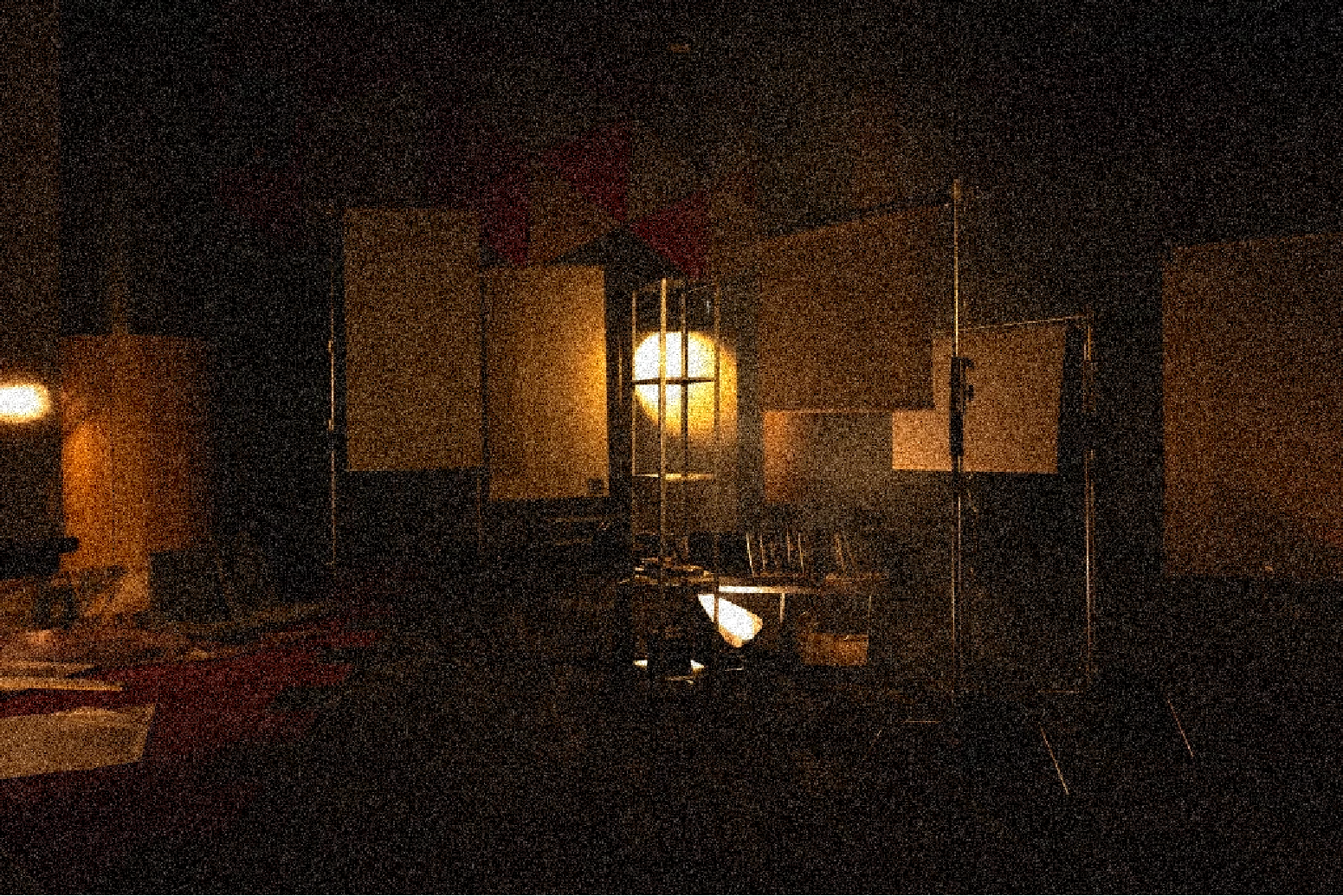
Rain Check , performance by Feelers
Their goal is to make things visible at this stage, putting things out on a conceptual level. And so they used performance to inform people about tech – which I thought was quite wonderful. Because of the way technology is so abstract, putting it into a digestible and simplified narrative will resonate with people more.
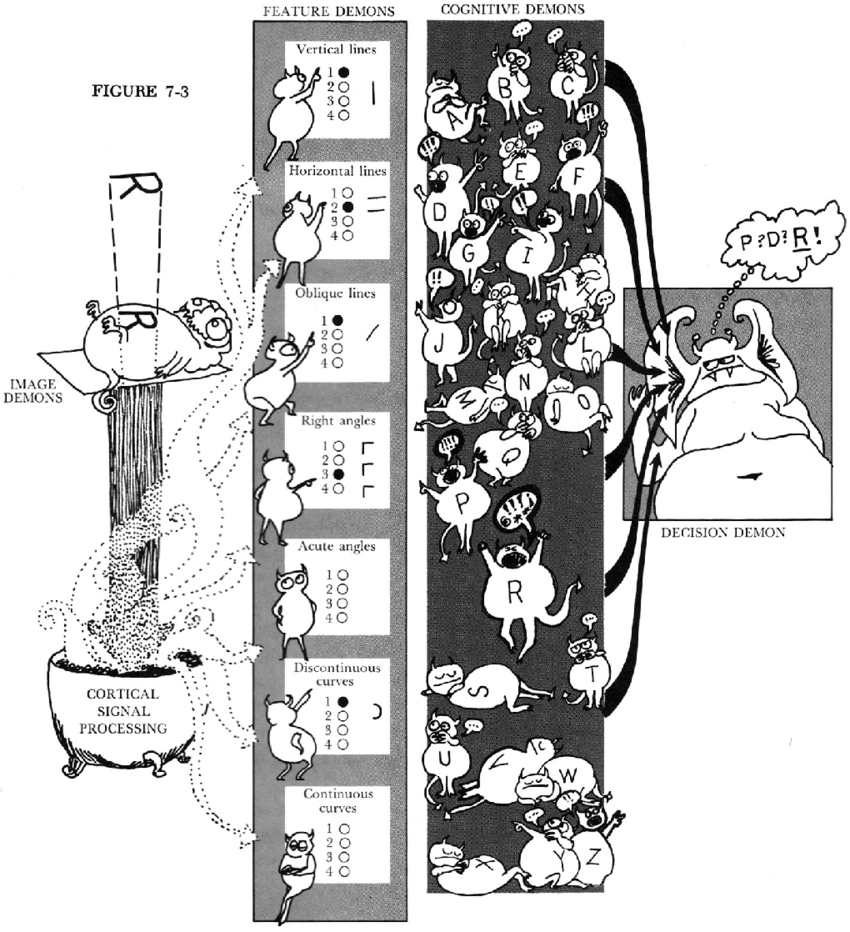
The Pandemonium Model
Food For Thought
The use of pattern recognition, as described by Selfridge (1959), also known as the Pandemonium model . It shows the various levels of demons which make estimations and pass the information on to the next level before the decision demon makes the best estimation to what the stimuli is. It was pretty amusing to see mind/cognitive processing visualised in this manner; understanding how visual images are processed through our brains through a narrative.
Ashley also introduced Jevon's Paradox in relation to tech efficiency: as we create more AI models to increase efficiency, we actually consume more resources. In the pursuit of optimization, it leads to greater complexity, which demands more computational power. Ironically, our efficiency tools become resource-intensive, defeating its original purpose.
→ More interesting keywords
• Permacomputing!
Design-based thinking; Embraces limits and restraints in the computing culture
• Aims to promote a sustainable way to produce technology. A critique of contemporary maximalist aesthetics and higher power
Out & About
As of this week I realised I haven’t been documenting my “Sound Walks” – little instances where I go out to record sound around Singapore. When starting this recording practice I didn’t have a plan in mind; I just knew I wanted to capture both urban and natural sound.
Thus far, it’s been pretty fun! Sometimes I get pleasantly surprised by the sounds I hear, or there are instances where all I get is silence (I’m looking at you, big trees). I’m using a Zoom H5 field recorder and a contact microphone, to record both ambient and deeper-level sounds. Both are investments I decided to make as I can foresee myself using them for a long time :D
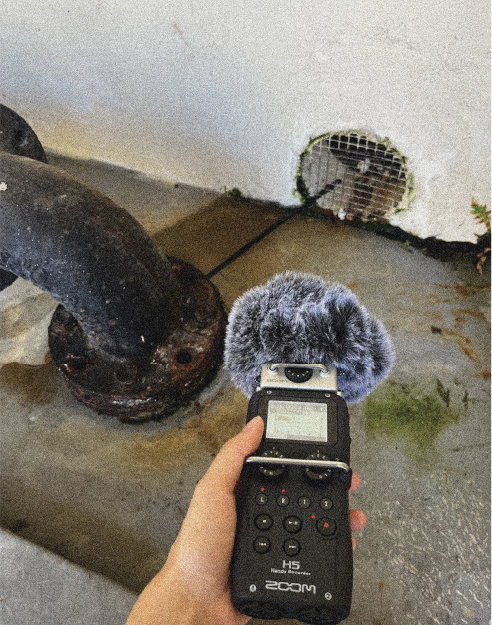
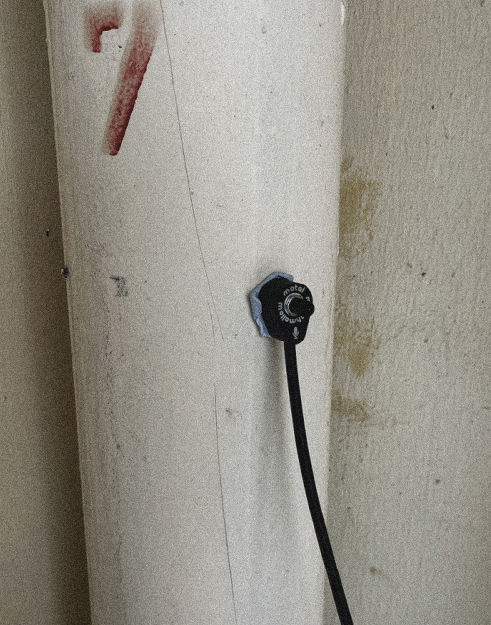
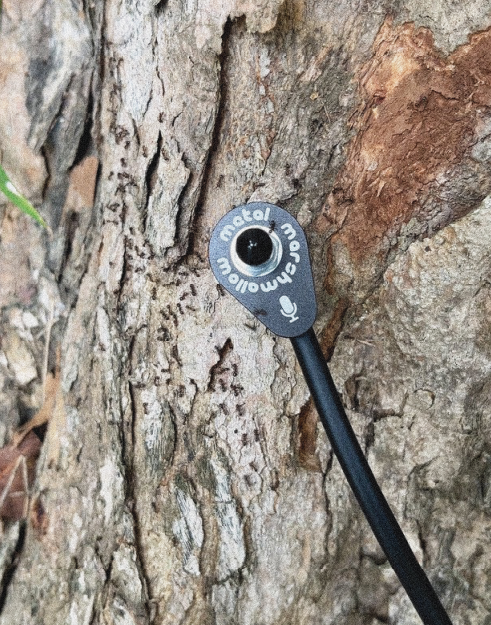
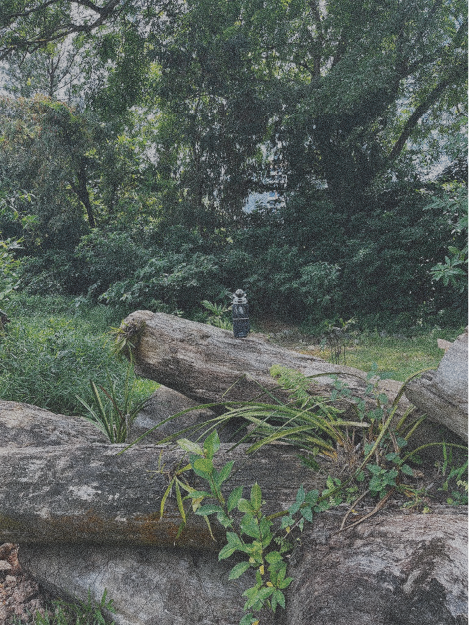
(1)Drain (2)Pipe near my house
(3)Ants on a tree (4)Fallen logs at Bididari Park
journal-for-listening
To document my field recordings, I decided to create a personal archive in website form. I’m not exactly sure about the layout of things yet, as I’m still recording things at my own pace – but for now, everything is “dumped” into columns on the site. Each recording is labelled and includes the time it was recorded. Clicking each titled recording will lead you to another page that plays the sound recorded, as well as a video (if available).
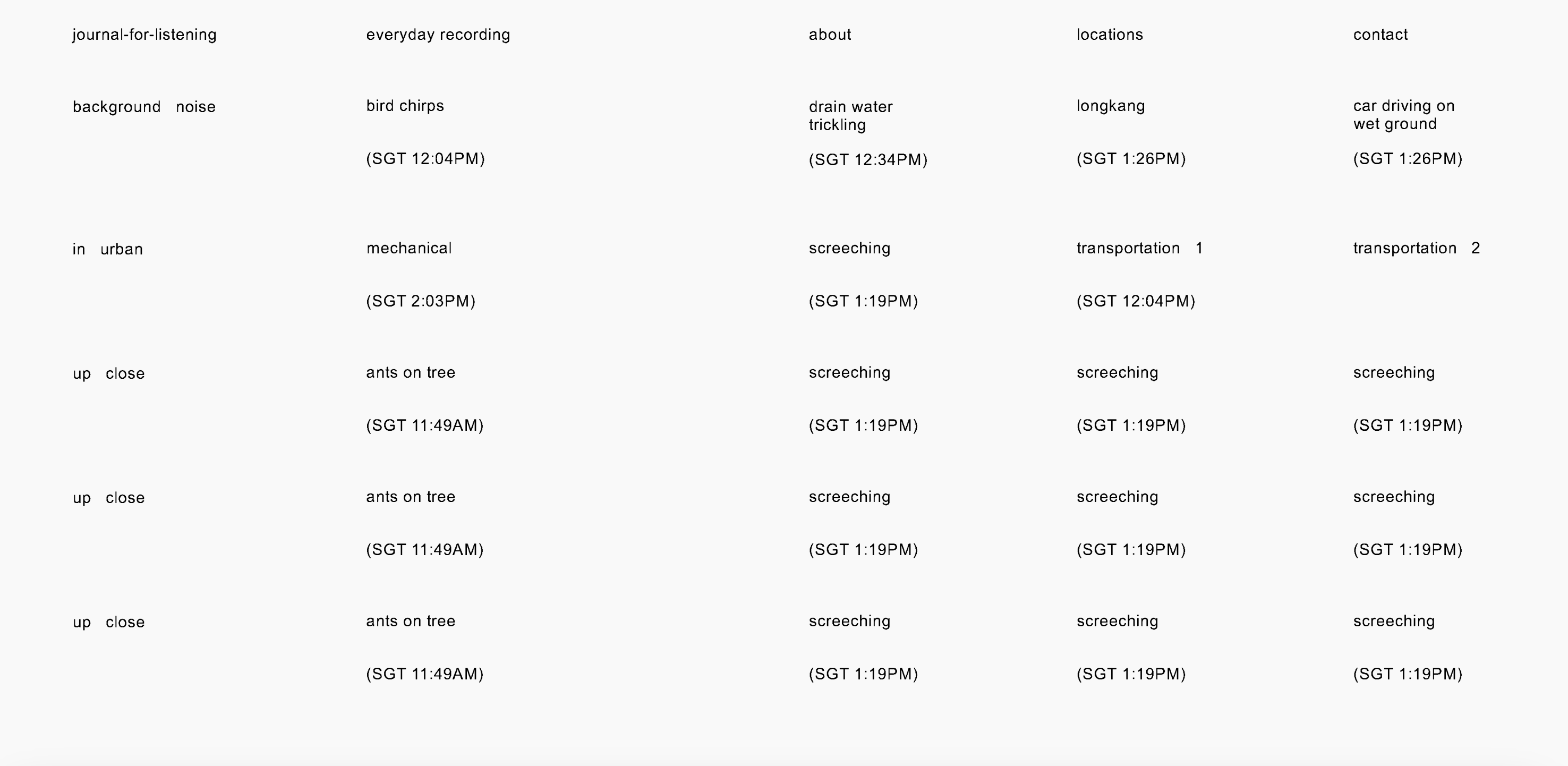
journal for listening! still a work in progress
I chose to document everything on a website as it feels more interactive and accessible. If I could, it would be nice to make this public so that more people could follow me on my recording journey 🙂 As of now, the site is kept simple and personal, with no fluff whatsoever. Just field recordings, presented in a journal-like manner. As time goes by, I’ll figure out the format of things better! Looking forward to see how things progress.
A Chat with Andreas
This week we had individual consultations to talk about our progress for our RPO and experiments. Thus far for my RPO, I was still in the midst of reading relevant books and shaping my research question in a clearer way. Other than that, it was going along - slowly and steadily.
Andreas commented that I was tackling too much with my research question, and could try narrowing it down further. I could also steer my project in a more design-oriented direction – since I am, after all, studying a course in Design Communication. The way my project takes shape is completely up to me, but there should still be some elements of design.
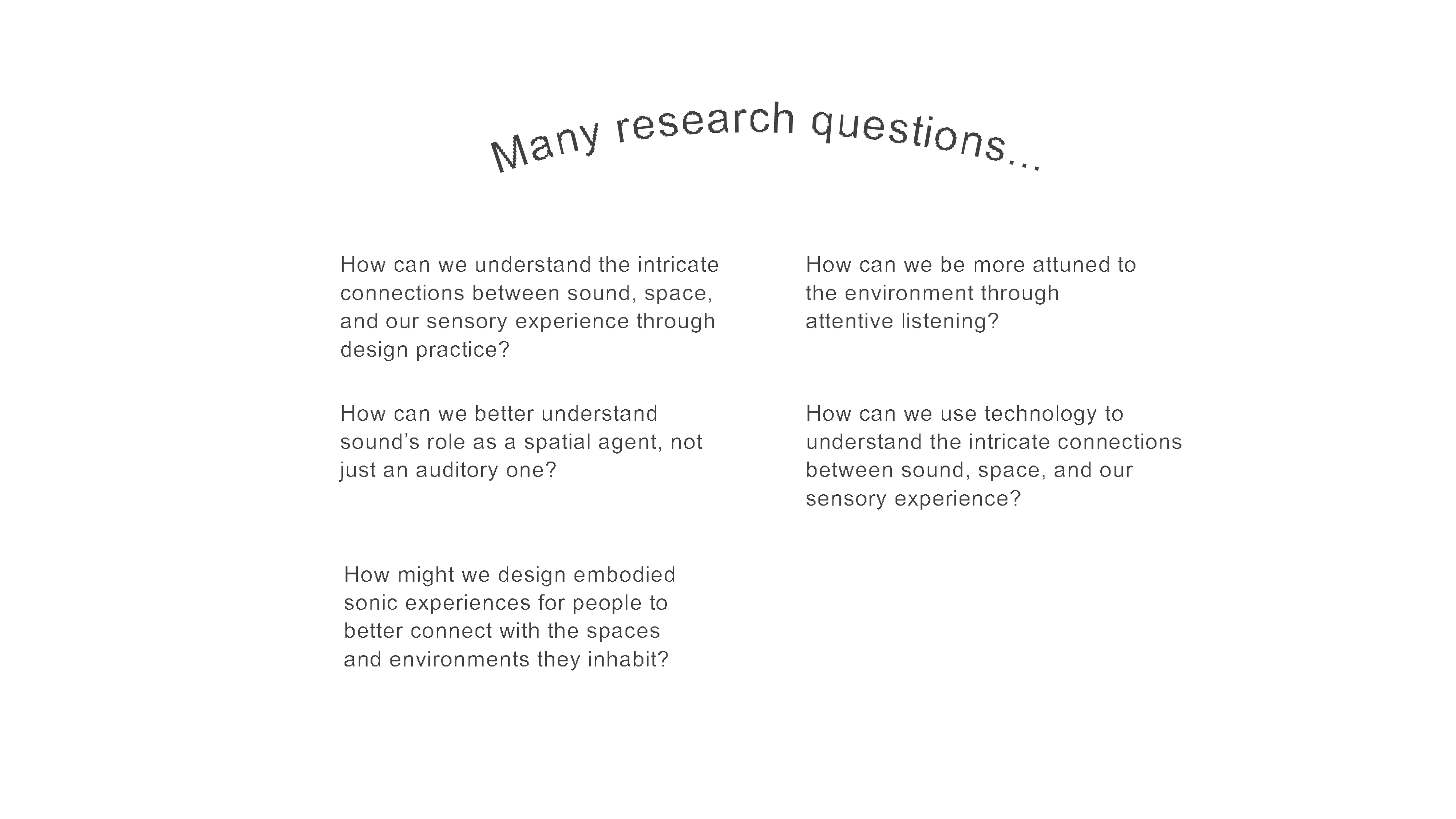
Moving on to my experiments, I’ll admit I was moving along at a relatively slow pace as I was concentrating more on my RPO. I have lots of ideas I want to do though, and I was trying to figure out which one I should start on first. Hearing this, Andreas suggested that I make a book of interesting things; stuff that interests me, and ideas I would like to materialise. Essentially a brain dump for my overwhelmed self. Since my brain was so fogged with ideas, this would help me (hopefully) track my ideas better.
Afterwards we had a little discussion on design. Till now, I was still struggling to find a link connecting design and Sonic Attunements. Which was a little soul crushing to me because I’ve been a designer for a few years now – so when I realised that the direction I was heading in could use more design direction, I was a little stumped.
"What is Design, even?"
Cue an existential crisis settling in.
Andreas reminded me that design doesn’t purely have to be about solving problems. It could go towards many directions; speculative design, interaction, critical making. It was all up to me on what message or goal I was trying to portray with my project.
Like I said, I had many ideas swimming in my head, including:
👉 Making my own analog synthesizer
👉 Turning foraged items into instruments
💭 Could I give it a voice, a sound?
💭 What character does it have, and why?
💭 Could I design that character?
👉 Could I utilise motion sensors to trigger
sound in these objects?
👉 The idea of sound as a material
👉 Altering and shaping it as a medium
At the end of it all, I was reminded that I could make a lot of things. A product. A instrument. A installation. An experience. An exhibition. Through many rounds of iterations, testing, and feedback, it would help me define what I want to do. Andreas remarked that the field recordings and soundwalks functioned as field work, falling under the category of observations and ethnographic research. In using sound as a tool to connect ourselves to our surroundings, I would have to find a way to bring it back to my design practice as well. That I will think about in more detail in the weeks to come.