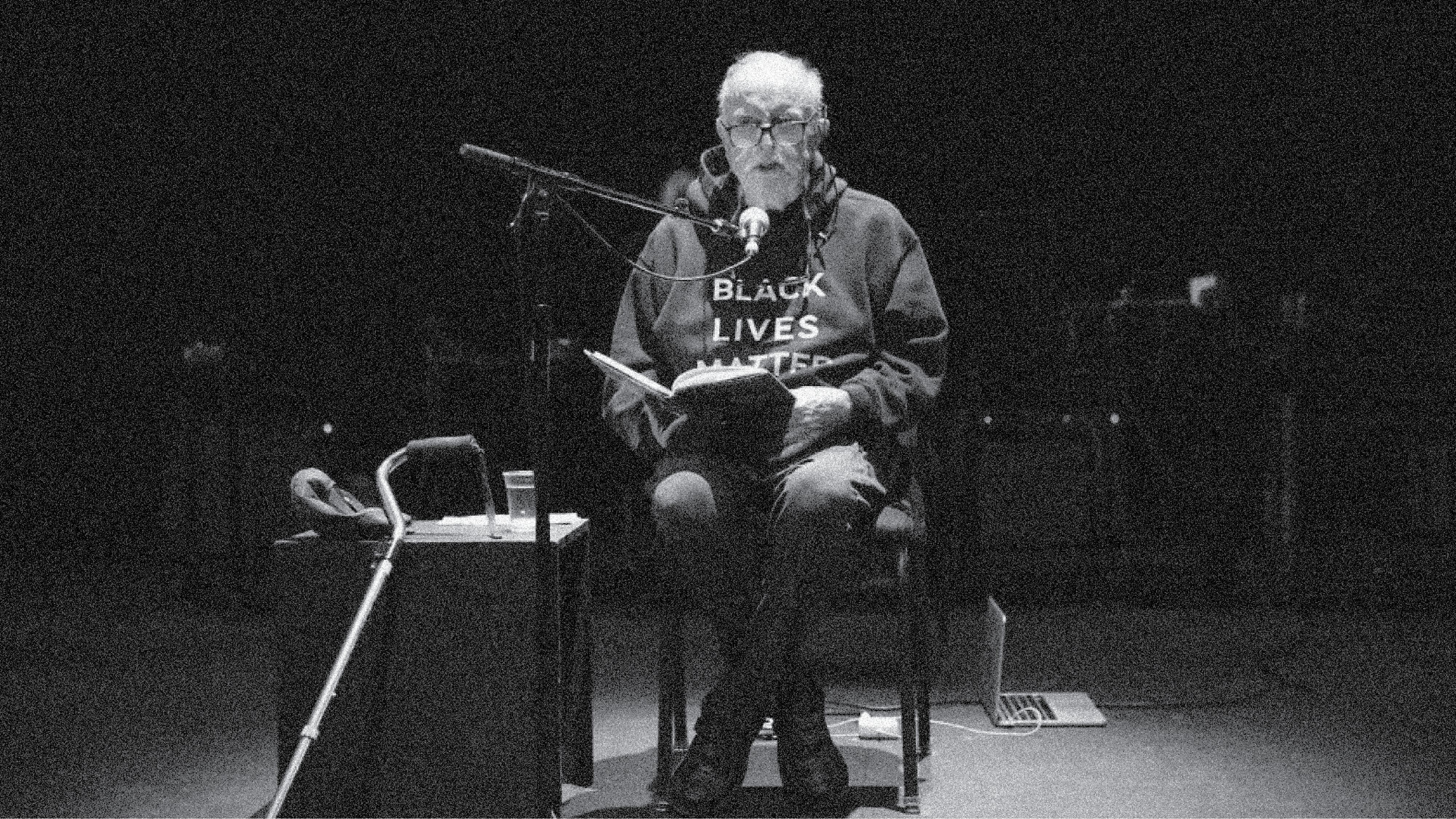
Alvin Lucier’s “I Am Sitting In A Room” (1969)
“Uncertainty is really big in the beginning.
Don’t think in such a transactional way, just do things.”
– Andreas Schlegel, 2025
With this in mind, I went ahead and started brainstorming for my first experiment. One thing that’s been of interest to me lately is the idea that every space has its own acoustic quality; sounds, reverberations, and vibrations are all things that make up a place’s sonic signature. So with this first trial, I wanted to do something revolving around sound and space.
One prominent example that experimented with this theory was Alvin Lucier’s “I Am Sitting In A Room”.
Audio recording of Alvin Lucier's "I Am Sitting In A Room" (1969)
To begin, Lucier read a text into a microphone, speaking: “I am sitting in a room, the same one you are in now. I am recording the sound of my speaking voice.”
As described in the text, his voice was recorded, then played back into the room. This process was repeated, and with each iteration Lucier’s recorded speech gradually grew more muffled, sounding distant, eventually degrading to reverberations, then to tones.
Slowly, the frequencies of his voice that match the resonances of the room were enhanced, and the room’s tones takes over his voice. Yes, its a lot to comprehend … but a very fascinating study on how sound materializes in a space.
Inspired by this, I decided to do my own take on this, trying this out with ambient noise instead of a central voice. Would the effect still be the same?
Experiment 1 - Walkway Resonance Study
Finding the resonant frequency / naturally distorting the surrounding sound in a space.
- Location: Lasalle level 3 walkway
- Time:
8 September 2025, 9pm-10pm
- Crowd Level: Mild, not too crowded
- Noise Level: Medium, with occasional student chatter all around
- Application: 2 transducers on a big glass panel
The Process
9.14pm:
To begin, conduct a 2 minutes recording of the space. Keep the recording device still; do not interfere unless needed.
Name this recording (2nd_rendition).
9.41pm:
Play recording (3rd_rendition) back in the same space. At the same time, hit record and record for another 2 minutes.
Name this recording (4th_rendition).
9.21pm:
Play recording (1st_rendition) back in the same space. At the same time, hit record and record for another 2 minutes.
Name this recording (2nd_rendition).
10.11pm:
Play recording (4th_rendition) back in the same space. At the same time, hit record and record for another 2 minutes.
Name this recording (5th_rendition).
9.35pm:
Play recording (2nd_rendition) back in the same space. At the same time, hit record and record for another 2 minutes.
Name this recording (3rd_rendition).
This is the final recording of the experiment - you may choose to continue if you want to.
Resonant Walkway Study: Audio Recordings
Hover over each image to hear the recorded sound.
Turn your volume up! If nothing plays, do refresh the page :)
Recording 1, 9.14pm
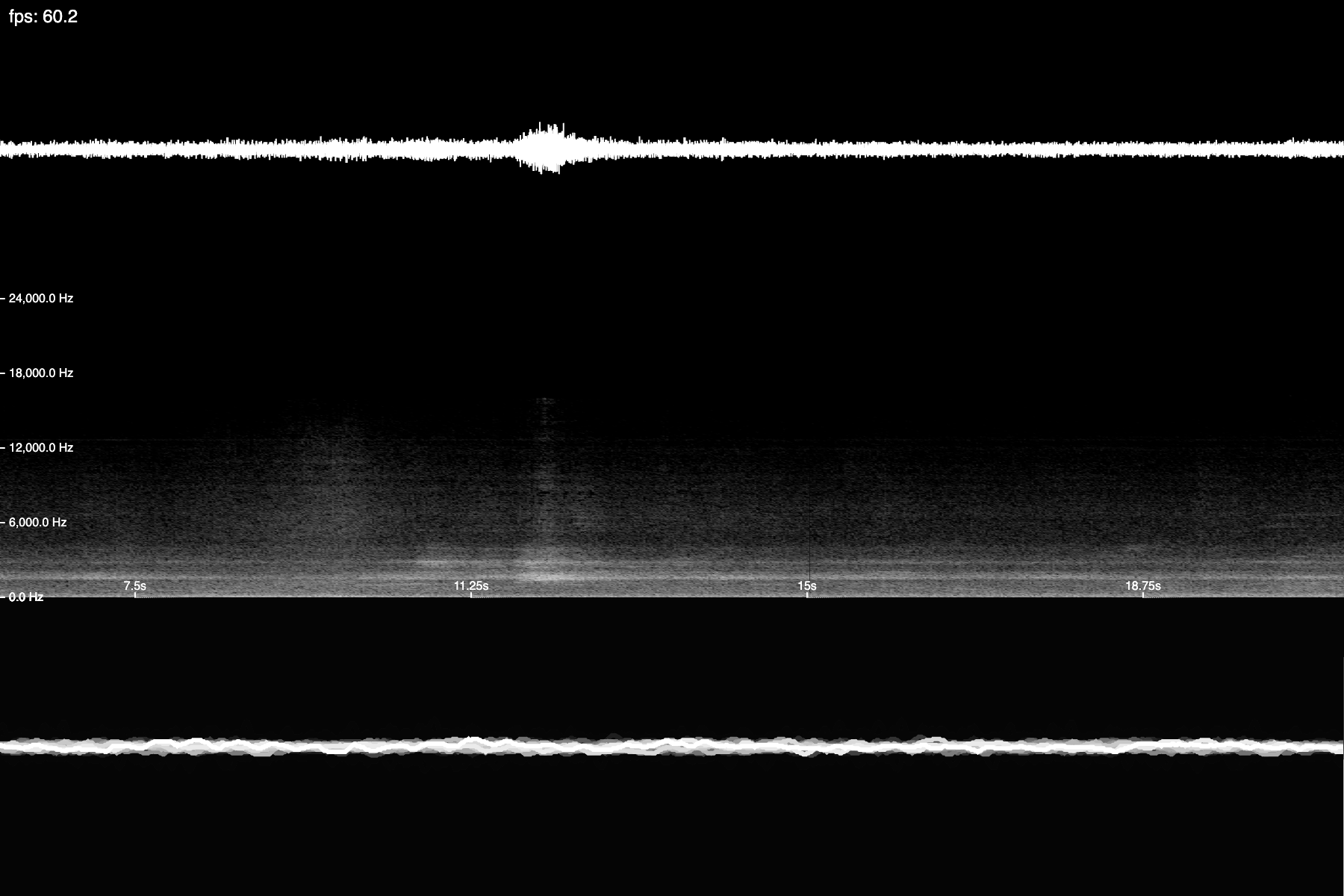
Recording 2, 9.21pm
Recording 3, 9.35pm
Recording 4, 9.41pm
Recording 5, 10.11pm
I didn’t exactly have a clear goal in mind when I carried out this experiment; all I was interested in was to hear the echoes and hollowness of the walkways, an understand what would happen if I combined audio transducers with different surfaces - in this case, the big glass panel.
This experiment was inspired by Alvin Lucier’s “I Am Sitting In A Room” - where he repeatedly records and plays back his own voice reciting a text, each time re-recording the result in the same room. As the process repeats, the room's unique acoustic properties (its resonant frequencies) are reinforced, gradually turning the speech into something else entirely. My experiment feels somewhat like that – but instead of a central voice, the atmospheric sounds in an outdoor setting was utilised.
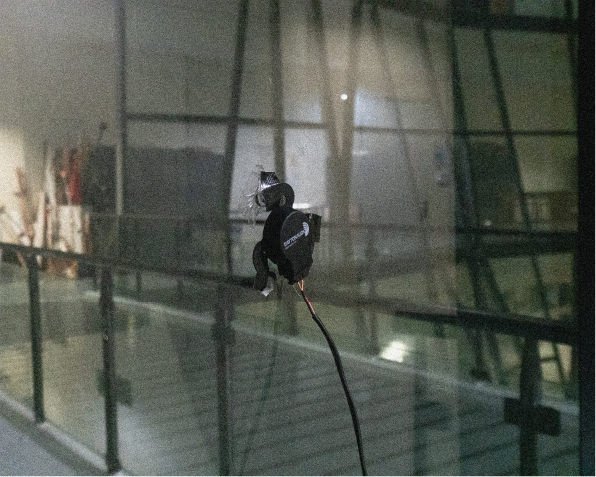
Transducer on the wall
I wouldn’t say I arrived at a clear conclusion for this. It was a fun experiment for me to see what happens when I played with sound in a “natural” way, simply replaying it without adding any additional changes. Nevertheless, it was interesting to hear the change from the first recording to the last. I wonder what would happen if this was repeated 200 times; would there be any audible traces left?
→ Experiment 1 Keywords
• Resonance
• Natural acoustics of a space
• Feedback and reverberation
• With each iteration, the resonant frequencies of the location gets amplified.
Mini Experiment 1.1
Sound mapping
I also ran a quick experiment connecting sound and space digitally. I recorded and 3D-scanned the space below my house, then imported both audio and scan data into TouchDesigner to make the space appear audio-reactive. The original field recording was too quiet to drive the visuals, so I substituted it with louder audio. Despite this compromise, it worked — the 3D space moved in accordance with the sound's rhythm and intensity.
Honestly, I don’t know what to feel about this mini experiment. Sure, it looks cool and all but … whether I can continue on from here is another issue. For now, I’ll save this one for the archives.
Feedback!
Andreas commented on the idea of sound and space; what kind of spaces am I looking to investigate? Would it be home, work, or transient space? (temporary spaces) For each of us, we have personal routines that defines a space. Thinking about it, I didn’t really like the idea of narrowing down my area of focus to specific locations; I wanted to keep my research open to any acoustic environment.
My first experiment felt speculative , adopting an experiential approach as an analysis and synthesis of sounds within the space. The idea of raw sound in my experiment sparked certain questions: How does this relate to design? The idea of putting sound into a space, was like putting a space into a space. Hearing this, it got a little complicated from there and we both got a little confused ahaha.
Anyway, he suggested I look into electronic music during the 1950s to 1960s. Those were the times where a lot of “primitive technology” were used, informing the way people looked at sound and produced it. Musique Concrète was what it was called; it was a type of music composition that utilized recorded sounds as raw material.
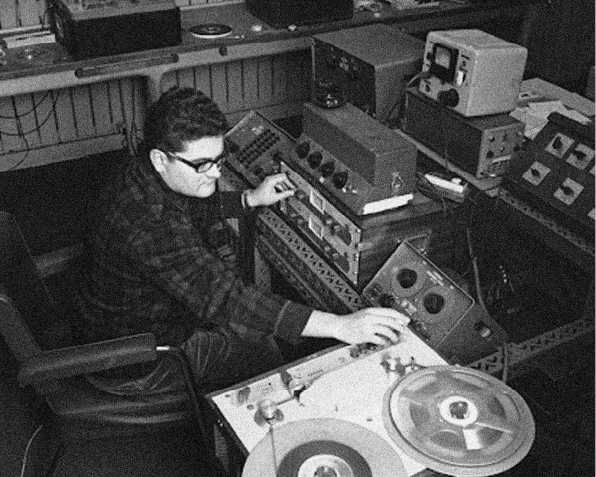
Pierre Henry in the 1950s, influential musique concrete artist
I could also look into the granularity of sounds, zooming into microsounds. It could all get really technical, focusing on frequencies and tones. Do I really want to head in this direction? I don’t know, but we’ll see. I guess the main question of the experiments heading forward should be: Where is all this going? What can I achieve out of all these experiments, findings, and research? Overall, through experimentation, its about building a playground of ideas; developing them to become more conceptual through a speculative/technical approach.