Caption: [sound of rain]
Mapping It Out: Mindmapping Exercise
Its been a while since I’ve sat down to actually create a proper mindmap. At the moment, our topics feel super broad so mindmapping would help us break it down into keywords for better understanding.
This was mine:
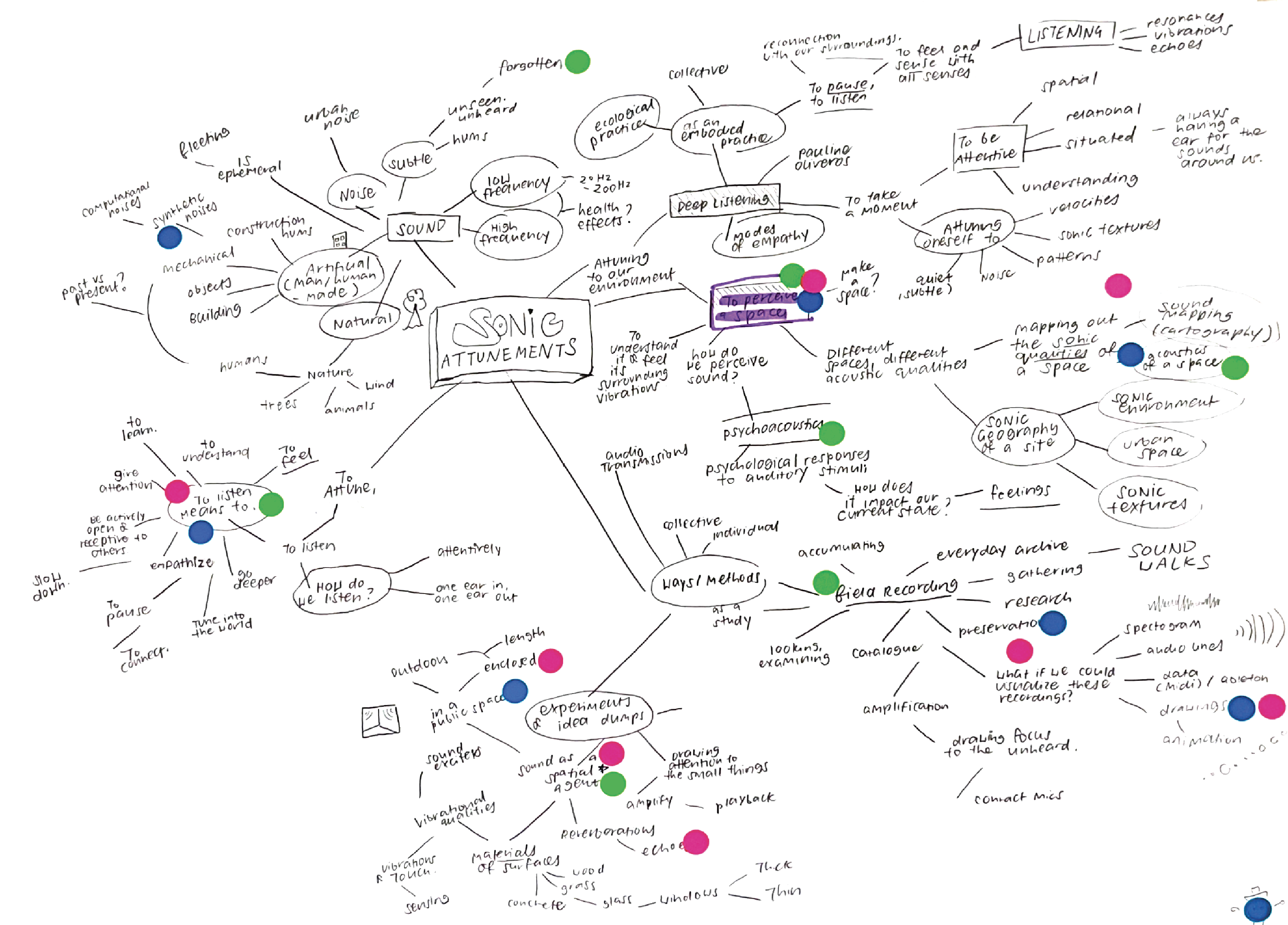
In the midst of creating my mindmap, Andreas remarked:
"That's a lot of stuff."
– to which I wholeheartedly agree. It was pretty crazy.
(1) (2) (3) (4)
But I promise there was a structure to it! It was broken down into:
Okay that’s a lot.
Did the mindmap help me break down my massive topic into simpler terms? I would think so! Seeing it all written down into keywords and expanded into even smaller keywords was somewhat useful. As someone with a scattered mind, I wouldn’t say it helped me simplify things, but it definitely helped me visualize my topic in neater sections.
Afterwards, everyone moved around the table, marking standout concepts on others' mindmaps with colored sticker dots.
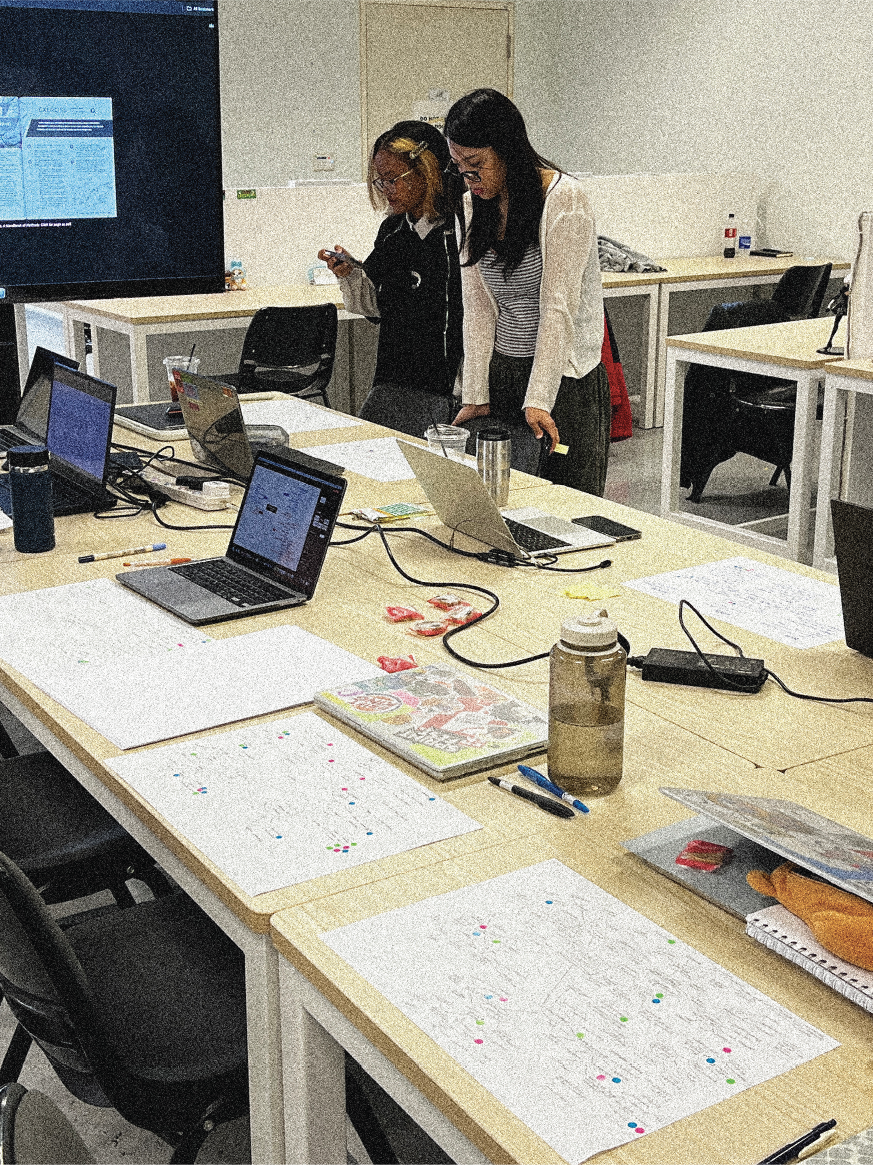
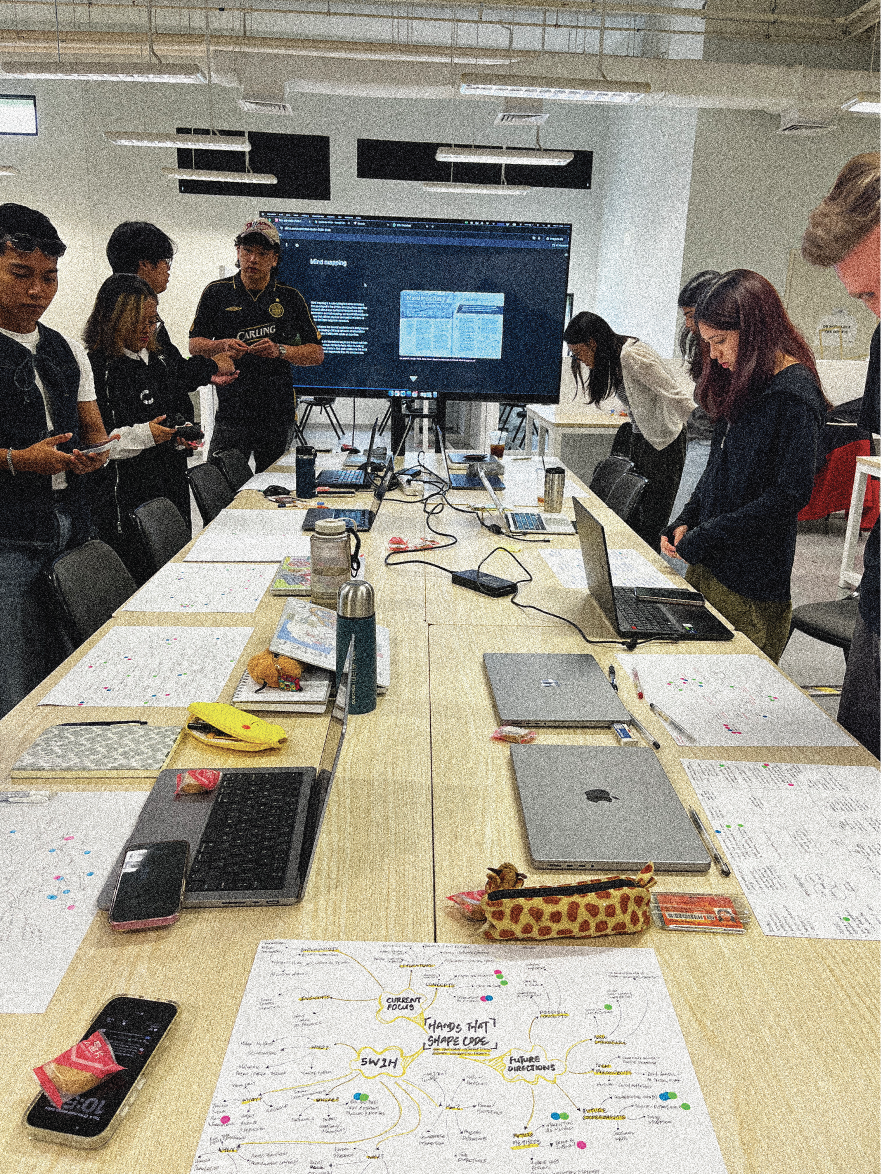
Pictures of everyone putting dots on each others' mindmaps
My atelier mates pasted the most number of dots on these words:
🔴🟢🔵 : To perceive a space
🟢🔵 : Acoustics of a space
🔴🟢 : Sound as a spatial agent
🟢🔵🟢🔵 : What if we could visualise these surroundings?
🔴🟢🔵 : To listen means to…
Someone commented that they liked the simplicity of the phrase “To listen means to…” as it made them think about the act of listening. I could expand on it more from a reflective point of view, perhaps realizing this for my experiments?
Seeing these dots, I’ll take some with a pinch of salt, and explore some points further. This exercise was great as we could understand the “feedback” and thoughts of others with regards to our topic. Some people might empathise with things I don’t, and view words from a different perspective.
To conclude the week, Andreas also left us with some little reminders:
Start making!
Many of us are feeling inertia.
Inertia, meaning a fear to start something. And this is often the most difficult stage. Its perfectly okay to start small, to begin crafting little things. It could even be as tiny as a drawing, a poem, or a video. For this semester, its okay to go fast and create as much as possible; mistakes might happen but that’s alright.
Work with others!
Have discussions, utilise the open studio layout!
In using the studio as a thinking space, there is room for collaboration and feedback. As designers, working with others is important, in order to obtain opinions that could inform our work better.
Making should be a routine.
With the thinking and reading, there should be the making.
Both should go hand in hand, informing each other. Andreas also gave us a tip: Whenever we have an idea, sit down and give it 3 minutes. Take this 3 minutes to evaluate it – we can either give up on it, or pursue it. If the idea lingers in the mind, then there’s no need to think that much anymore; follow through with it!
In a nutshell, Semester 1 is for experimentation — trying everything. Semester 2 is for iteration, where the project actually evolves. Through cycles of prototyping, revision, and refinement around a central idea, our project grows. By incorporating feedback, embracing failure, and remaking, constant reflection and analysis will lead to a clearer outcomes. The first attempt never hits the mark, hence its better to begin imperfectly than not at all.
There was also the question of impact: Vikas reminded us at the beginning of the semester that we won’t be able to create projects that will “change the world”; and that’s perfectly fine! As designers, we are encouraged to find solutions for the greater good, for society or other communities. Our work shouldn’t just be self-expressive, but it should create awareness, or help people. In design, there should be an impact and a purpose in the things we put out.
Critical Journal Seminar
I also attended two seminars this week, Critical Journal and Case Studies. After going through both, I’ve decided to settle with Critical Journal as it feels more relatable for my project.
By utilising this as a framework for our project, it establishes practice-based research – using the outcomes from our making to contribute to new knowledge, insights, perspectives, and findings. This could happen the other way round too. Essentially, action research and design-led research all falls under this big framework. It is an iterative process; thinking, making, criticising, and so on.
Shu Min simplified this into 3 terms: Contextualising, Reflecting, and Making. These are the 3 stages of the Critical Journal process to follow. Contextualising comes from our readings, stemming from knowledge we learn. Reflecting is looking back at this knowledge, understanding it, and speculating on it. Making is where we experiment or make prototypes. There’s no set order for these 3 stages, they could happen at any stage.
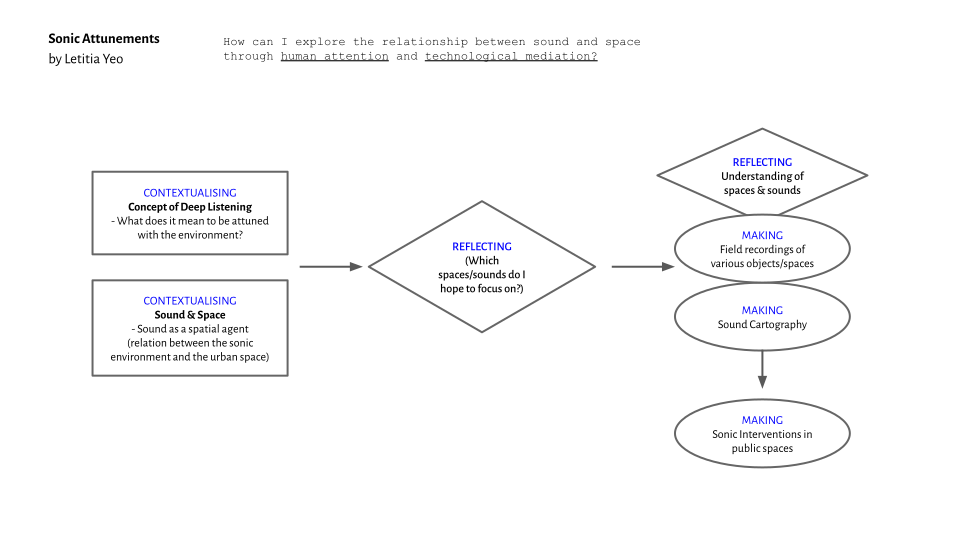
Sonic Attunements: Process framework
We were asked to define these 3 stages in our making process. The path ahead still feels a little unclear, so I can definitely see this changing in the weeks to come.
Out and About: The Listening Biennial
Curated by Alecia Neo, Soledad García Saavedra, Suvani Suri with Brandon LaBelle.
Over the week, Singapore Night Festival was happening so I went to visit The Listening Biennial, an artistic, research initiative focusing on listening as a relational capacity. The biennial encourages visitors to step into the space of Third Listening; discovering ways of interconnection amidst differences amidst a bold soundscape.
One of the works that was particularly interesting was My Tiny Space by Rachel S.Y. Chen, about the idea of connection despite coming from different backgrounds. Functioning as an immersive, interactive installation, at the heart of it all was the Magical Musical Mat (MMM), that transformed interpersonal touch into music. When two people touch the mats at the same time, and establish skin-to-skin contact with each other, the soundscapes playing will shift. It doesn’t work without physical contact.
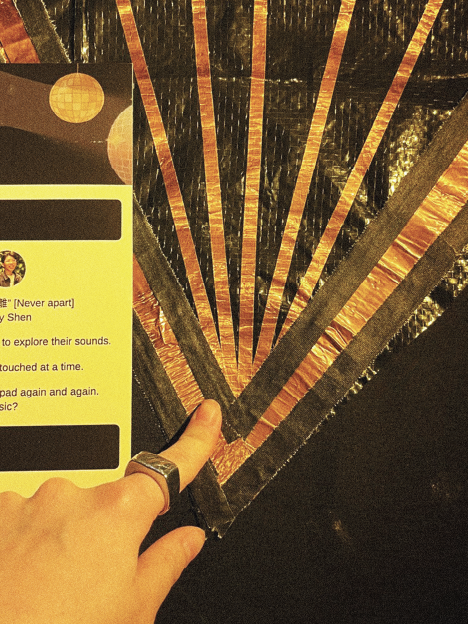
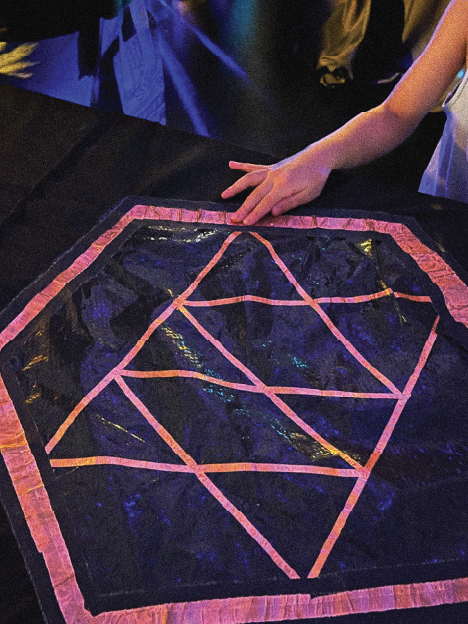
My Tiny Space :D
Experiencing this was coooooool. I’m guessing the artist used copper tape connected to the music source, which causes the shift in music when touched. Its such a simple concept, yet a powerful one as it brings people together through touch. As Singaporeans, we all have our walls up when interacting with each other. This installation was an initiative for us to interact without prejudice or judgement.
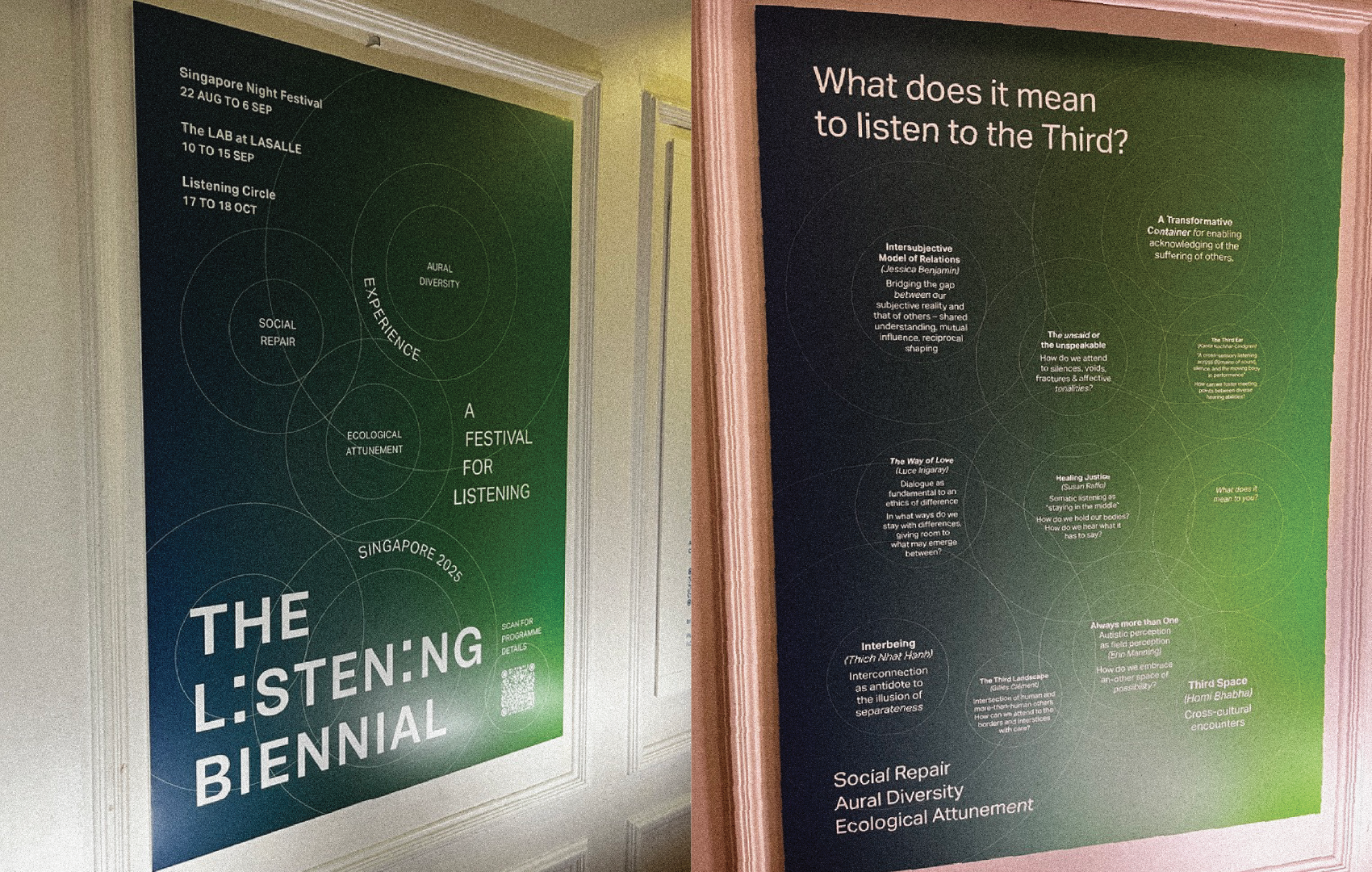
More pictures from The Listening Biennial
On Third Listening – on volume to listen!
On Third Listening was another interesting installation. Using soundscapes from various artists, all audiences had to do was listen. The room was filled with about 15 speakers, and beanbags for us to sit on. We all listened in silence for as long as we wanted, in mid-darkness. The sounds were loud but not over-bearing; our attention wasn’t drawn to anything else but the sounds itself.