Recording along Bidadari Park
Personal Sound Walk
This week, I decided to go on a Sound Walk to better understand the way I listen – to see what it would be like to simply walk and listen, in an attempt to feel more attuned to my environment. To prepare, I created a listening score: a list of open-ended instructions to guide one on how to listen and walk. To be honest, I've never done a Sound Walk before, so this served as a first trial to see how it would go. I'm planning to hold this Sound Walk for other participants in the future, so conducting a few walks on my own first is crucial.
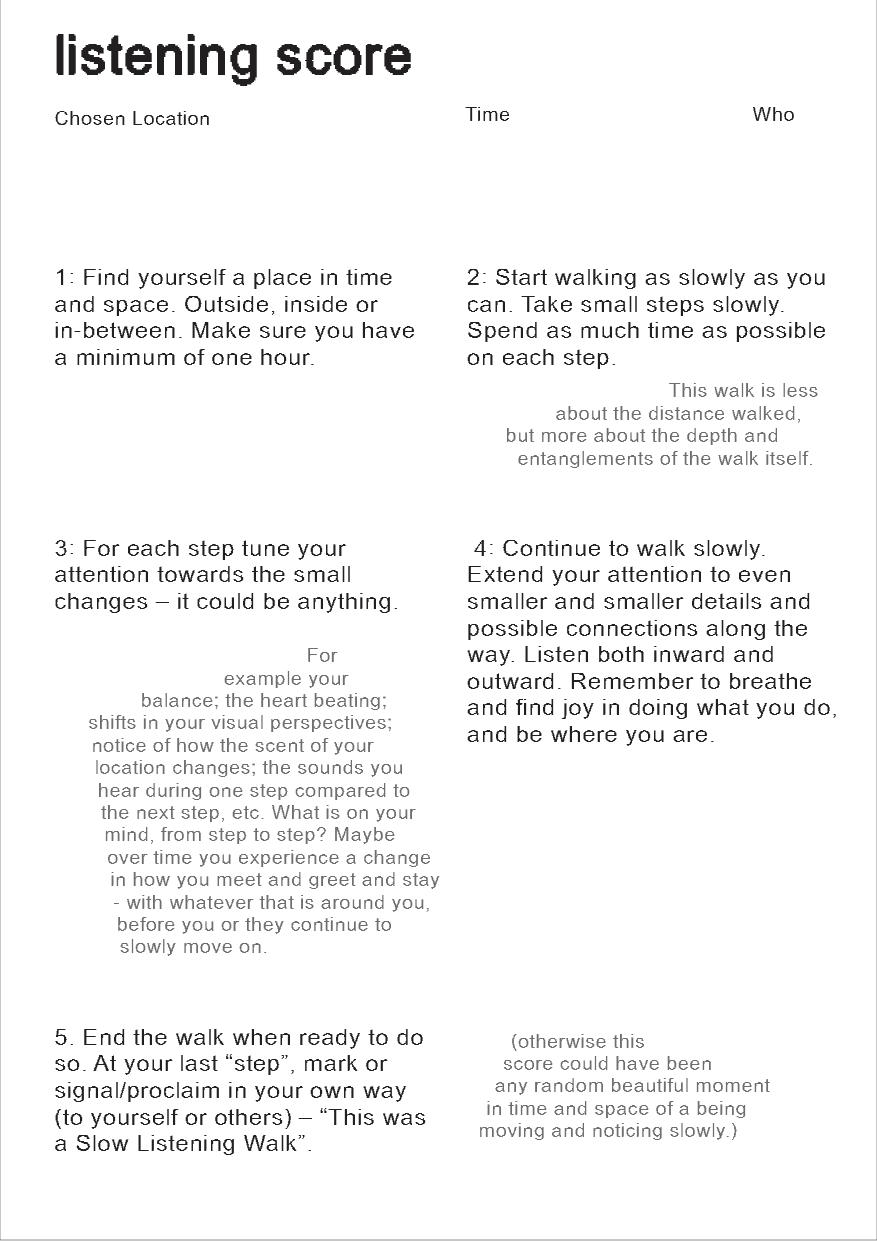
Listening Score
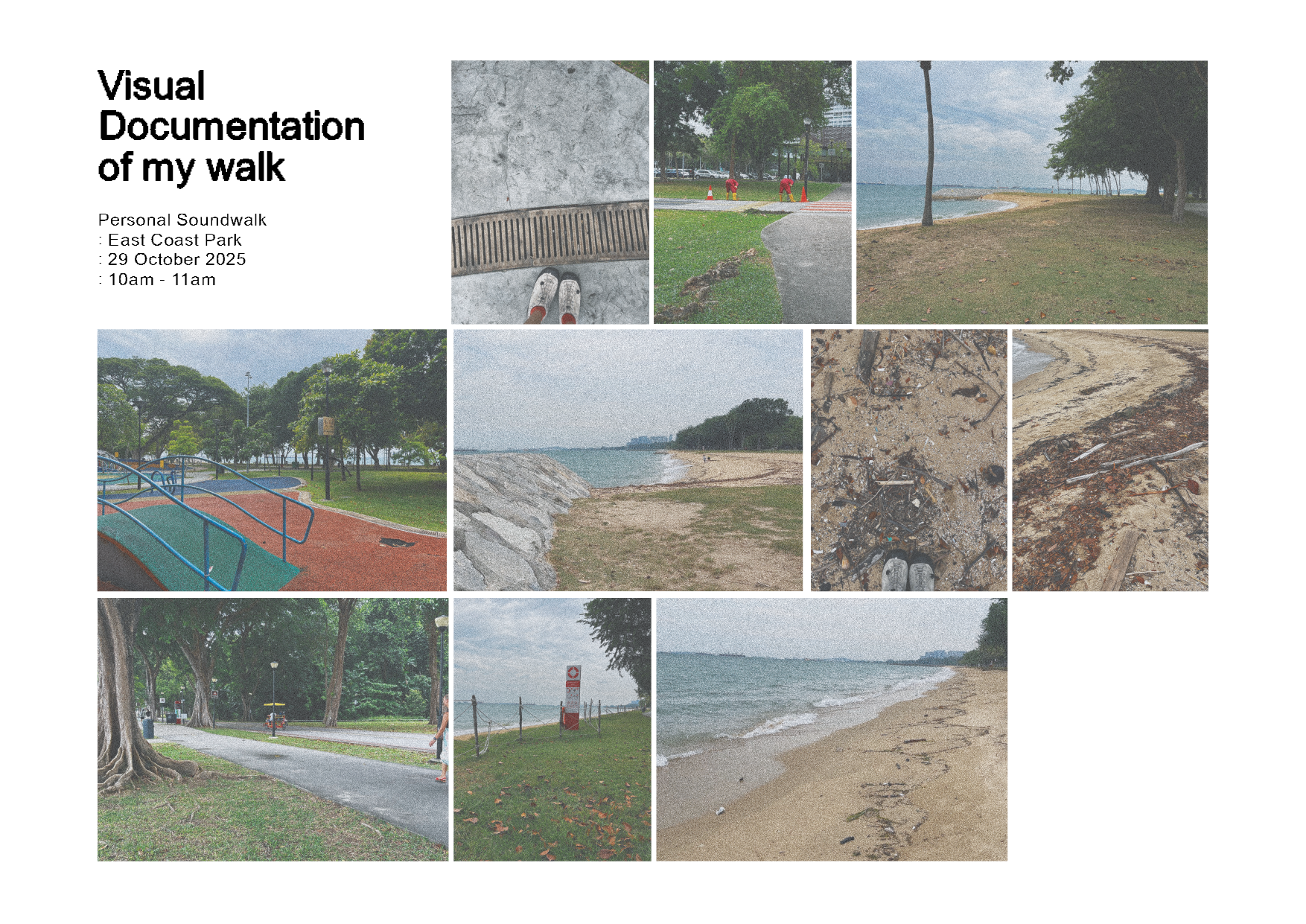
For my first location, I chose East Coast Park as I wanted to listen to nature. Starting from a quiet place, away from the city, felt ideal too. Giving myself an hour, I started from wherever I felt like starting and tried my best to walk in the direction my listening led me. From the starting point, I recorded my entire journey from start to end.
It was relatively quiet that day, being a weekday; the only people around were elderly folk and joggers. I tried my best not to get visually distracted, but rather, auditorily distracted. Following the listening score, I subtly took note of how slowly I walked, and what sounds I was most attracted to or repelled by. In the end, I stopped the walk at 30 minutes.
A snippet of the recording taken
Afterwards, I sat by the side to reflect on the walk, jotting down notes in a small notebook I had brought along. I dedicated another 30 minutes to listening to my recording again, before drawing my response to it. It was a time of peaceful listening and self-reflection; I really felt myself pausing and slowing down during that hour to truly listen and understand my environment.
To conclude, I came back to school and decided to mould my personal response to the walk in clay. I chose clay as it was an easy material to shape with my hands, and I felt it was almost an extension of the body itself. Playing back the audio recording, I sat down and moulded the clay carefully. Eventually, an abstract clay sculpture emerged, representing my Sound Walk at East Coast Park.
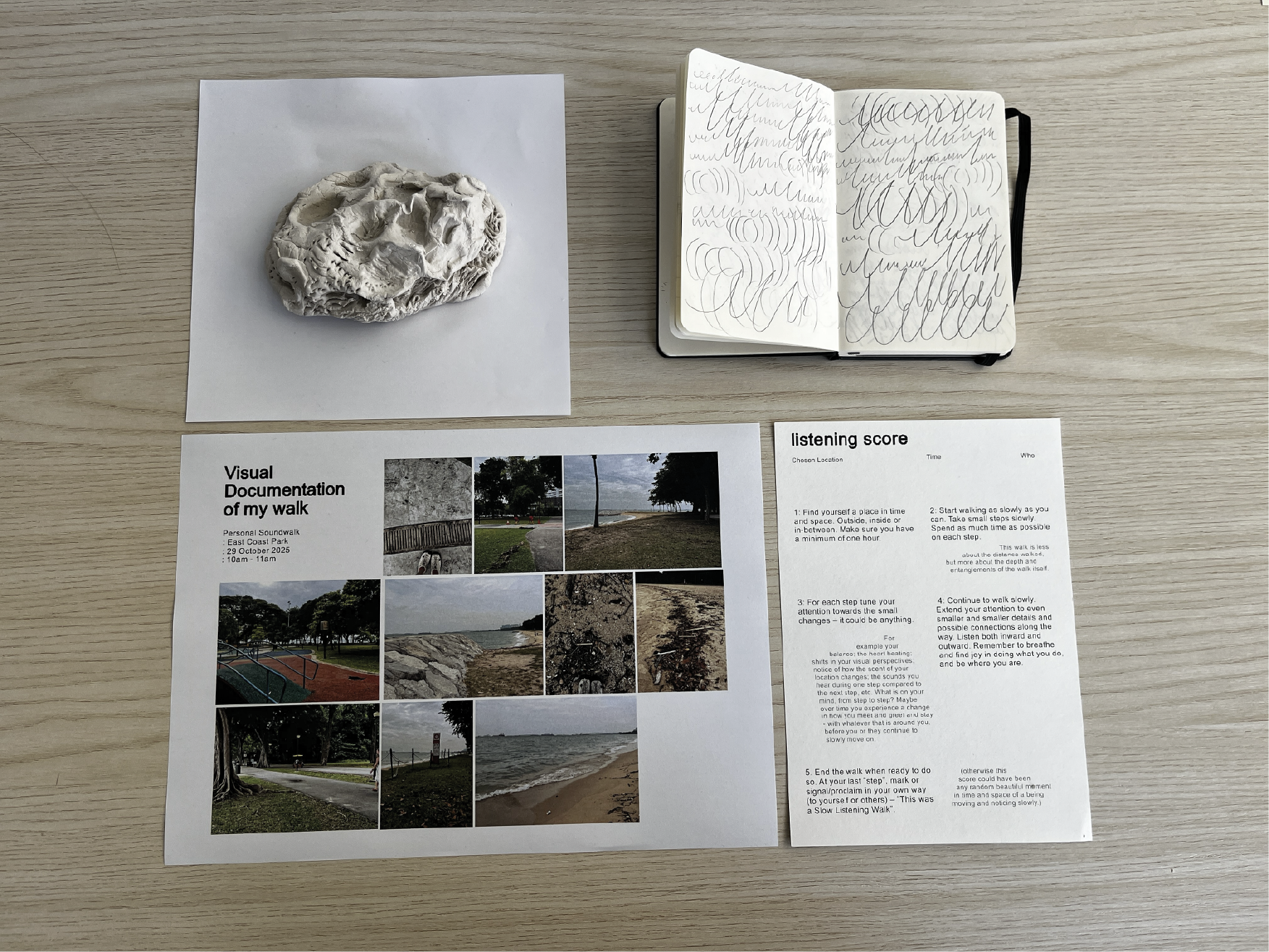
Recorded responses
A mini reflection from clay making
To begin, I responded directly to the sounds present in the recording — footsteps, mechanical noises, waves, winds. These elements prompted me to create creases and dents in the clay. Using my hands, I molded crevices into various parts of the clay, noticing I did this most intensely during the loud gusts of wind captured in the background. In fact, wind was the dominant sound throughout the walk — it was super heavy that day! This I expressed through more vigorous kneading. Sharp, unusual sounds like construction and mechanical noise became sharp line markings molded into the clay. The crashing waves of the sea stood out as well, so I also sculpted wave-like forms. The final result presented as something quite fluid and abstract; funnily resembling a coral reef.
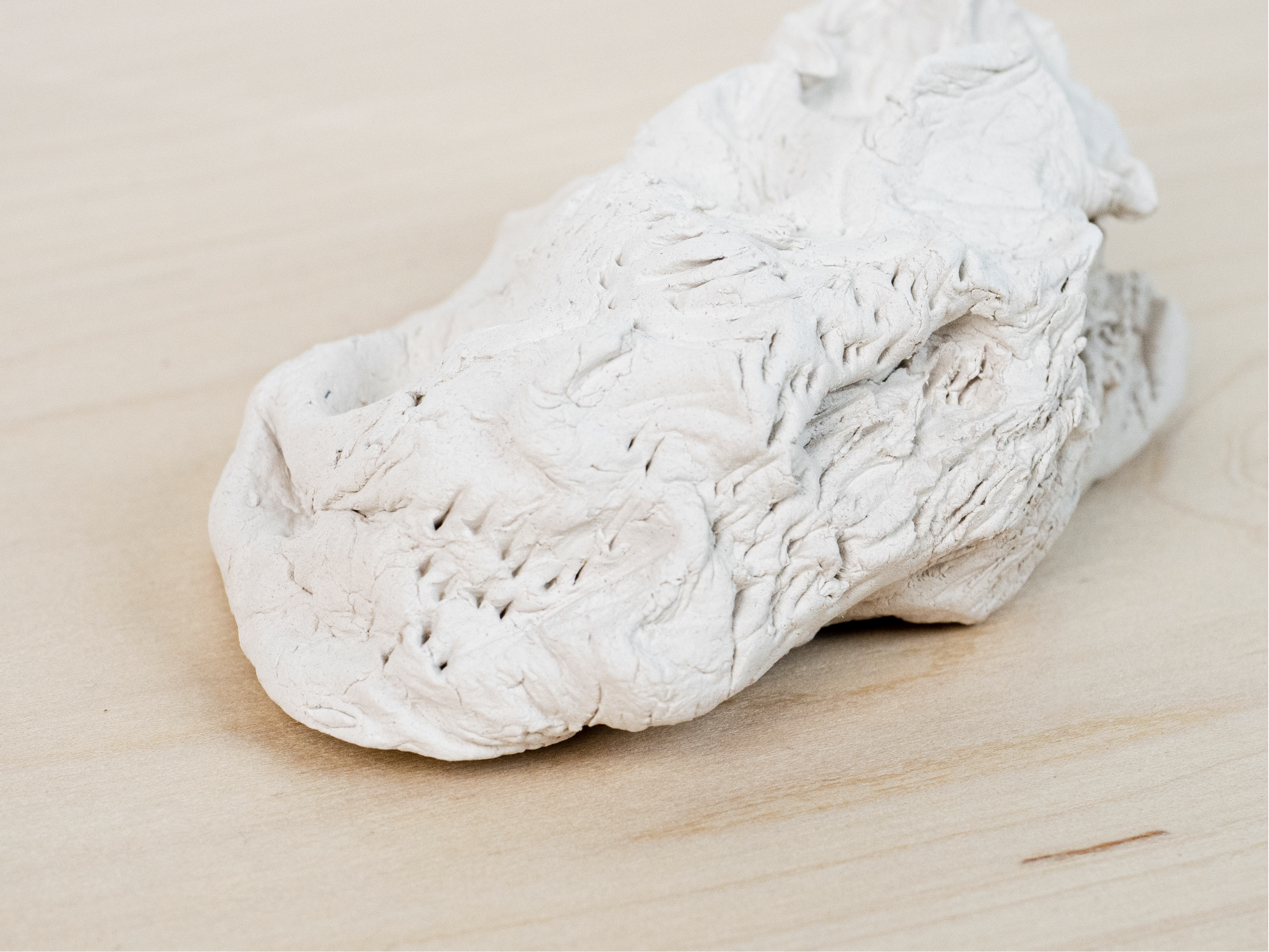
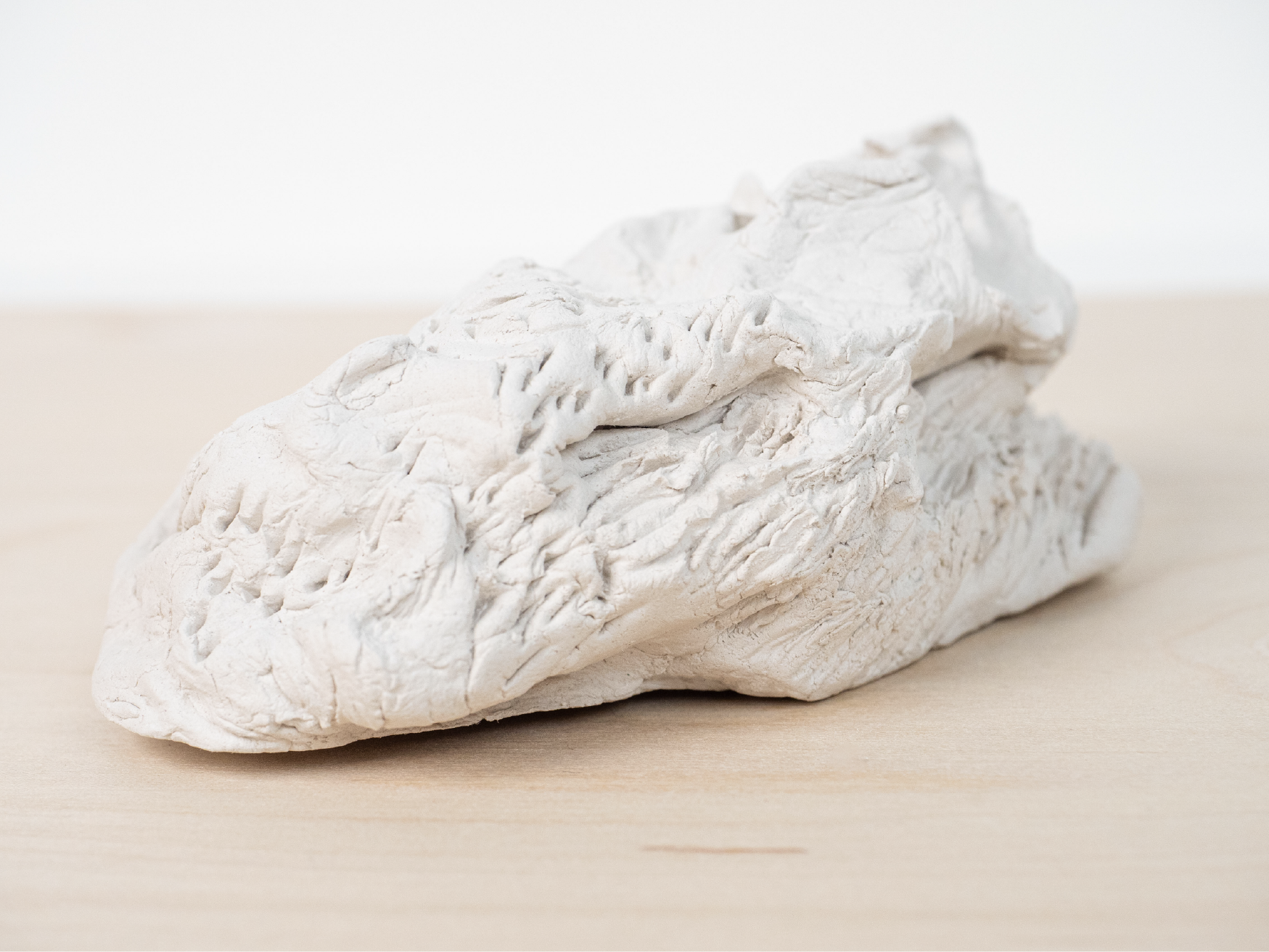
Final clay structure
Intimate Acoustics: A further exploration into making tiny sounds
Remember my dilemma with what material to use to create tiny sounds? This time, I decided to forget it all and use foraged and leftover items instead; including trash left behind by myself, and things I came across along the way that caught my interest.
Armed with two DC motors, I used a leftover coffee can, leaves, plastics, and a tiny nail to shuffle against blocks of wood. To make noise, the end of the DC motor needed something to scrape against the wood. Using tape as a super DIY method, I attached a small ball chain and nail to the end before bringing it into contact with the wood blocks. The sounds produced were interesting: there was the "tok tok tok" of the nail against wood, and the rough shuffle of a leaf scraping over a plastic sheet.
Feedback
Andreas liked the "data" collected from the Sound Walk – the drawings, written reflection, pictures, clay, and audio recording. These were all good probing tools to generate data, whether visual, abstract, or physical. He recommended I look into psychogeography: the act of purposefully drifting through the city. This method is thought of as an alternative way of reading the city – Wilfried Hou Je Bek calls it "the city-space cut-up." The theory was invented by Marxist theorist Guy Debord in 1955, who suggested playful and inventive ways of navigating the urban environment in order to examine its architecture and spaces.
The reimagining of the city proposed by psychogeography has its roots in Dadaism and Surrealism, art movements that explored ways of unleashing the subconscious imagination. It is a method of seeing the city anew; a way of critically investigating the psychogeography of place.
Andreas also introduced me to the term autoethnography: an approach to research and writing that seeks to describe and systematically analyse personal experience in order to understand cultural experience. He said that my Sound Walk felt somewhat like that.
As for the outcome I got from the DC motors, he thought it was still quite DIY and messy for now. How can I document it in a neater way – a way that's suited for galleries and exhibitions?